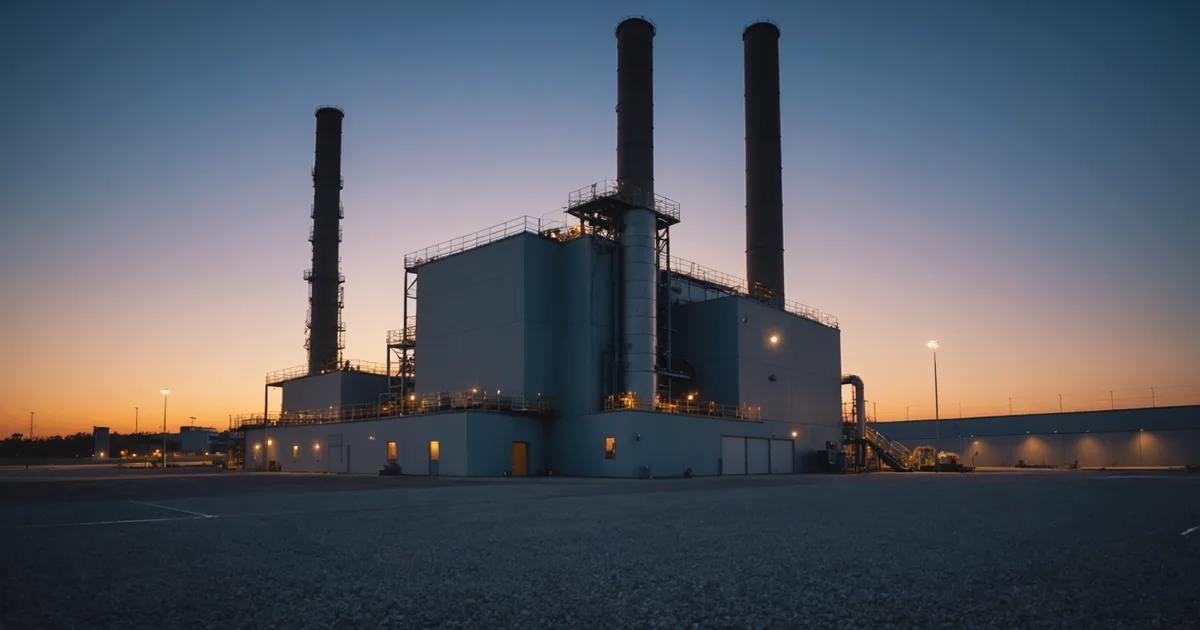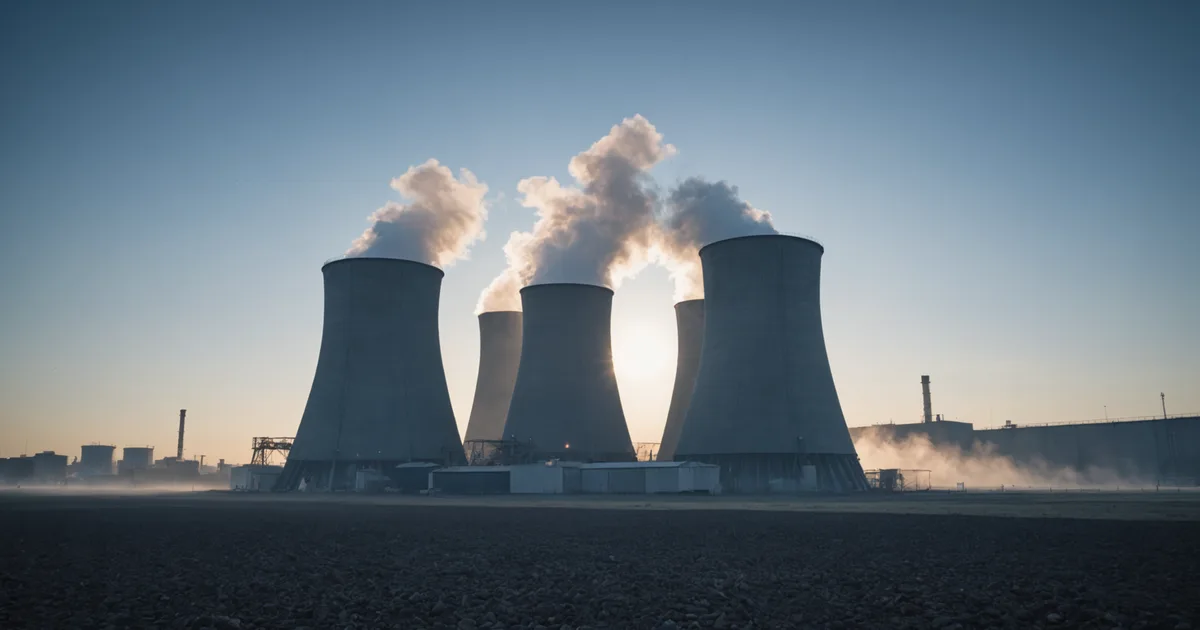
A fission reactor is fundamentally a heat source. The nuclear chain reaction produces thermal energy, and the power generation cycle converts a fraction of that thermal energy to electricity using a turbine generator set. The conversion efficiency depends on the thermodynamic cycle: a light-water reactor plant operates with steam conditions in the range of 285 to 320 degrees Celsius, giving a Rankine cycle thermal efficiency in the range of 32 to 35 percent. Higher-temperature designs can push this further, but the physics of steam cycles imposes a ceiling that no design can fully escape.
The implication is straightforward: for every megawatt of electricity delivered to your facility, the reactor produced something between two and four megawatts of thermal energy in total, with the remainder discharged to a cooling loop. Most nuclear plant designs treat this rejected heat as a waste product to be disposed of through cooling towers or a water body. Some industrial applications see it differently.
Where the Thermal Energy Goes in Standard Configurations
In a conventional power-only configuration, the condenser and cooling tower system reject the non-converted heat to the ambient environment. For a 50 MWe plant with a 33 percent thermal efficiency, this means approximately 100 MW of thermal energy is continuously rejected through the cooling system at temperatures typically in the 40 to 60 degree Celsius range at the condenser outlet. This low-grade heat has limited industrial utility.
A different architecture is possible for operators who have uses for higher-grade heat: extracting steam from intermediate points in the turbine cycle before it reaches the condenser, or in some reactor designs, directly tapping the primary or intermediate coolant loop for heat exchange with an industrial process. The temperature and pressure available at the extraction point depends on the specific cycle design, but in many configurations, steam or working fluid at 150 to 250 degrees Celsius is extractable without eliminating the power generation capability entirely.
For certain industrial co-location scenarios, this changes the economics considerably. An operator with both a power need and a process heat need can potentially meet both from a single fission plant, reducing the total capital deployed relative to buying grid power plus a separate industrial boiler system.
Industrial Applications That Can Use This Heat
The useful industrial applications for medium-grade nuclear process heat break roughly into three categories by temperature requirement. The first is district heating and building conditioning, which generally requires water or steam at 60 to 120 degrees Celsius. The second is process water heating, dewatering, and evaporative concentration processes in food processing, chemicals, or wastewater treatment, typically in the 80 to 180 degree range. The third is low-pressure industrial steam for manufacturing processes, which can range from 120 to 250 degrees Celsius depending on the application.
We are not trying to make the case that every data center operator should be thinking about process heat sales. The primary application we design for is power delivery to compute infrastructure, and for most data center co-location scenarios the process heat value-add is secondary or irrelevant. Data center cooling systems use heat, but at temperatures and in configurations that make integration with a nuclear power cycle non-trivial.
The scenario where process heat becomes financially interesting is when the fission plant is sited at or near an industrial facility that has a separate and significant thermal energy demand. A food processing complex or an industrial campus with chemical production might present this kind of opportunity. Or a district energy operator co-developing with a data center whose building complex includes significant space conditioning loads.
The Infrastructure Required for Heat Extraction
Implementing process heat extraction is not simply a valve you turn on. It requires design provisions that must be included from the start, because retrofitting a heat extraction capability onto a plant designed as a pure power station involves significant modifications to the turbine island and secondary systems. If the plant might serve a process heat customer in its operating life, the secondary loop architecture and extraction points should be designed in from day one.
The secondary circuit connecting the nuclear island to the process heat application must be completely isolated from the reactor coolant system, with multiple barriers ensuring that no radioactive contamination reaches the industrial process. This is standard practice in nuclear district heating designs used in several European countries, where regulatory frameworks for this application have been established. The heat exchanger design, pressure differentials, and monitoring requirements for these isolation barriers add cost and complexity but are well-understood engineering problems.
The process customer also needs to be located close enough to the plant to justify the heat transport infrastructure. Steam and hot water can be transported via insulated piping, but thermal losses over long distances erode the value. Practical co-location within a few hundred meters to a kilometer is the realistic range for direct steam or hot water supply without substantial auxiliary heating to compensate for transport losses.
What the Revenue Math Looks Like
The financial value of process heat revenue depends entirely on what the customer would otherwise pay for equivalent thermal energy. If the alternative is natural gas-fired steam generation at industrial gas prices, the reference price is a function of gas market conditions plus the boiler efficiency loss and O&M. At industrial natural gas prices in the range seen in recent years, the thermal energy equivalent value per MWh-thermal falls in a range that is meaningful against the capital cost of adding heat extraction capability to a plant design.
We are careful here not to assert specific revenue projections because they depend too heavily on variables we cannot fix: the gas price at the time the process heat supply agreement would take effect, the specific load factor of the industrial customer's heat demand, and the contract term over which the economics must hold. What we can say is that for industrial customers with large, continuous process heat needs, the opportunity to partially displace fossil fuel-derived steam with low-carbon nuclear heat is a value proposition that survives scrutiny when the numbers are worked through carefully with both parties.
Relevance to the Applied Atomics Design Direction
Our primary target application is power delivery to data center infrastructure, and the reactor design choices we are making are oriented around that application: stable electrical output, high availability, compact footprint, and dispatchability at the timescales data center operators need. Secondary heat extraction is a feature we are considering for the design, not an afterthought, because we want the plant to be useful for operators whose sites include non-data-center thermal loads.
Whether any given prospective partner has a use for the process heat capability depends on their site. We do not oversell it as a universal benefit. For the partner whose site is a pure data center campus with no adjacent industrial processes, the rejected heat goes to a cooling tower like any other thermal power plant and the secondary heat extraction hardware may not be worth the capital investment. For the partner building a mixed-use industrial campus, it may be a meaningful part of the total energy economics.
The honest framing is that on-site fission generates both electricity and thermal energy. Maximizing the value extracted from both of those outputs, where the site context permits, is good engineering and good economics. It does not change the fundamental value proposition for data center operators, but it does expand the range of site configurations where the investment makes sense.