Every serious conversation about compact fission eventually gets to spent fuel. It is a legitimate question and we would rather address it directly than let it sit as an unexamined concern. The waste question for a compact fission unit is genuinely different from the waste question for a utility-scale nuclear plant, and the differences are worth understanding clearly rather than summarizing with vague reassurances.
We are going to talk in terms of the design parameters we are working toward. We have not yet operated a plant, and we are not going to fabricate operational data that does not exist. What we can do is explain the physics of how spent fuel volume scales with reactor output, describe the regulatory and practical framework for interim storage, and be clear about what is known versus what remains to be demonstrated.
How Spent Fuel Volume Scales with Plant Output
A conventional light-water reactor at a large utility plant produces, very roughly, on the order of 20 to 30 metric tons of heavy metal as spent fuel per gigawatt-electric-year of operation. This number depends on the specific fuel burnup target, enrichment level, and the fraction of the original uranium that undergoes fission before discharge. Higher burnup fuel stays in the reactor longer and frees up more energy per unit mass before discharge, reducing spent fuel volume per unit of energy produced.
Scaling this proportionally to a 10 to 20 MWe compact unit, operated continuously at full output: the annual spent fuel production is approximately 0.2 to 0.6 metric tons per year, depending heavily on the fuel form and burnup design. Over a 20-year operating life, a single compact unit at those power levels might accumulate somewhere in the range of 4 to 12 metric tons of spent fuel. For comparison, a single large utility reactor accumulates that amount in a matter of months.
This is not a small quantity requiring no management. It is a real radiological hazard and must be treated as such. But the scale of the management problem is commensurate with the scale of the unit, and that distinction matters when thinking about what on-site storage looks like.
Fuel Form Matters
The physical form of the spent fuel significantly affects how it is handled and stored. Traditional light-water reactor fuel in zircaloy-clad pellet assemblies has a well-established storage pathway: cooling in spent fuel pools for several years until decay heat diminishes to the point where dry cask storage is viable, followed by transfer to NRC-licensed dry casks for interim storage at the plant site.
Compact fission designs being developed today use a range of fuel forms, including high-assay low-enriched uranium (HALEU) fuels in various configurations, tri-structural isotropic (TRISO) particle fuels embedded in graphite or other matrices, and metallic fuel forms. Each fuel form has different physical properties after irradiation, different decay heat characteristics, and different pathways for characterization and packaging.
TRISO fuel in particular has properties that make it attractive from a storage perspective: the fuel particles are individually encapsulated in multiple protective layers, which provides inherent containment of fission products even after discharge. Handling and interim storage of TRISO-based fuel is a different engineering problem from handling traditional rod assemblies, generally simpler in several respects, though the specific regulatory precedents for compact TRISO applications are still being developed through the NRC licensing process.
On-Site Interim Storage: What It Actually Looks Like
Current U.S. policy does not have an operational permanent repository for high-level nuclear waste. The Yucca Mountain project never received an NRC license, and the DOE's path toward a permanent geologic repository remains uncertain as of this writing. This is a real policy gap, and pretending it does not exist would be dishonest.
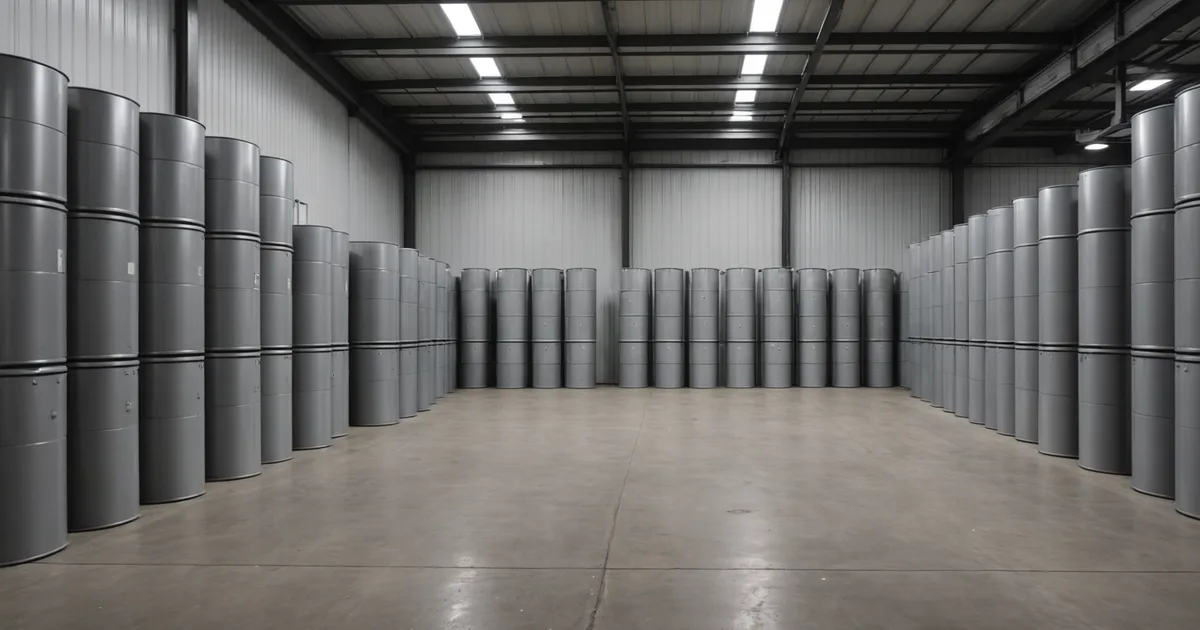
The practical consequence is that spent fuel from nuclear plants in the United States is stored at or near the plant site in licensed interim storage facilities, either wet storage in pools or dry cask storage. This is not the intended permanent solution, but it is the functioning one, and it has operated safely at utility-scale plants for decades. For a compact fission unit, the spent fuel inventory accumulated over its operating life is manageable on-site in a purpose-designed dry storage configuration. The footprint of interim storage for the spent fuel from one compact unit over its full operational life is small relative to the plant site.
The regulatory framework for dry cask storage is well-established for traditional fuel forms. For novel fuel forms used in advanced reactor designs, additional regulatory development is needed. The NRC has been actively engaged in developing guidance for advanced reactor fuel forms, and several topical reports on TRISO and HALEU fuel storage are at various stages of development. We track this regulatory work closely because our fuel storage design needs to align with what the NRC is developing.
Transport and the Back-End Fuel Cycle
Spent fuel transport in the United States is regulated under 10 CFR Part 71, which governs the design, testing, and use of packages for radioactive material transportation. Spent fuel is classified as Type B packaging, with strict performance requirements for accident conditions including free-fall, fire, and immersion. Approved Type B spent fuel transport packages exist and are in routine use for utility-scale fuel shipments.
For a compact unit, the annual discharge volume is small enough that shipment to an interim storage facility need not be frequent. Spent fuel would accumulate in on-site dry storage over the refueling cycle and be transferred periodically. This is an operational and logistical matter that requires advance planning with the transport packaging supplier and the receiving facility, but it is not an unsolvable problem. The infrastructure and regulatory framework for this type of transfer exists.
What We Are Not Claiming
We are not claiming that compact fission units produce waste that can be ignored or that the absence of a permanent U.S. repository is irrelevant. Both of those claims would be false. What we are saying is that the spent fuel management challenge for a compact unit is proportional to its output, that the volume over a plant lifetime is manageable, that established interim storage methods apply with modification for advanced fuel forms, and that the regulatory pathways are being developed in step with the technology.
The waste question does not disappear by pointing to small volumes. It requires advance planning, coordination with regulators, and commitments about how spent fuel will be managed over the operational and post-operational life of the plant. We treat this as a design requirement, not an afterthought. Our licensing basis will include a complete fuel management plan, and we engage with these questions as part of the normal engineering work, not as communications challenges to be minimized.